


Page 70 - newDATAmagazine | 14>06>2022
P. 70
new
                                                                                                           D
                                                                                                   newDATA
                                                                                                              A
                                                                                                                T
                                                                                                                  A
                                                                                                   M AGA ZINE
                                                                                                   MAGAZINE
                 Physical Layer impairments


                                          on C-band networks: Part II


            This  article  analyzes  some  physical  layer     calculated for the optimal power per channel,
         impairments  (PLIs)  of  the  hardware                which  is  different  for  all  architectures.
         components belonging to the nodes and of the          Therefore, the OSNRs calculated considering
         overall  network,  such  as  non-linear               only  ASE  noise  power  or  both  ASE  noise
         interference  (NLI)  noise  and  crosstalk            powers  and  NLI  power  cannot  be  directly
         influence. The analysis will focus on the most         compared.
         feasible  and  cheaper  horseshoe  network
         solutions  (which  results  from  a  study  made
         through  the  data  present  in  Source  1),  CD
         ROADM  B&S  (which  is  the  most  common
         solution for metropolitan networks), and FD&W
         using coherent detection (ChD) nodes N1, both
         combined with CD ROADM R&S nodes N2 (see
         my article on newDataMagazine nº11).
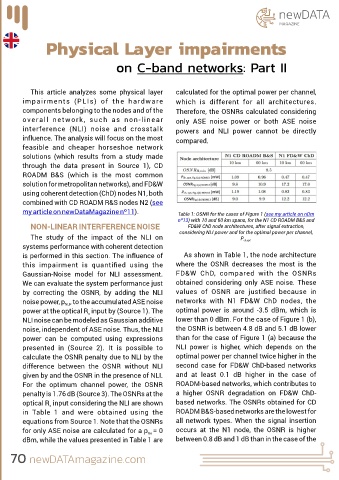
                                                                Table 1: OSNR for the cases of Figure 1 (see my article on nDm
                                                               nº13) with 10 and 60 km spans, for the N1 CD ROADM B&S and
            NON-LINEAR INTERFERENCE NOISE                          FD&W ChD node architectures, after signal extraction,
                                                                considering NLI power and for the optimal power per channel,
            The  study  of  the  impact  of  the  NLI  on                            P ch,opt .
         systems performance with coherent detection
         is performed in this section. The influence of            As shown in Table 1, the node architecture
         this  impairment  is  quantified  using  the           where  the  OSNR  decreases  the  most  is  the
         Gaussian-Noise  model  for  NLI  assessment.          FD&W  ChD,  compared  with  the  OSNRs
         We can evaluate the system performance just           obtained  considering  only  ASE  noise.  These
         by  correcting  the  OSNR,  by  adding  the  NLI      values  of  OSNR  are  justified  because  in
         noise power, p , to the accumulated ASE noise         networks  with  N1  FD&W  ChD  nodes,  the
                        NLI
         power at the optical R  input by (Source 1). The      optimal  power  is  around  -3.5  dBm,  which  is
                                x
         NLI noise can be modeled as Gaussian additive         lower than 0 dBm. For the case of Figure 1 (b),
         noise, independent of ASE noise. Thus, the NLI        the OSNR is between 4.8 dB and 5.1 dB lower
         power  can  be  computed  using  expressions          than for the case of Figure 1 (a) because the
         presented  in  (Source  2).  It  is  possible  to     NLI  power  is  higher,  which  depends  on  the
         calculate the OSNR penalty due to NLI by the          optimal power per channel twice higher in the
         difference  between  the  OSNR  without  NLI          second  case  for  FD&W  ChD-based  networks
         given by and the OSNR in the presence of NLI.         and  at  least  0.1  dB  higher  in  the  case  of
         For  the  optimum  channel  power,  the  OSNR         ROADM-based networks, which contributes to
         penalty is 1.76 dB (Source 3). The OSNRs at the       a  higher  OSNR  degradation  on  FD&W  ChD-
         optical R  input considering the NLI are shown        based networks. The OSNRs obtained for CD
                  x
         in  Table  1  and  were  obtained  using  the         ROADM B&S-based networks are the lowest for
         equations from Source 1. Note that the OSNRs          all  network  types.  When  the  signal  insertion
         for only ASE noise are calculated for a p = 0         occurs  at  the  N1  node,  the  OSNR  is  higher
                                                     Rx
         dBm, while the values presented in Table 1 are        between 0.8 dB and 1 dB than in the case of the


     70 newDATAmagazine.com

