


Page 39 - newDATAmagazine | 02>06>2021
P. 39
There is no denying that the modelling of real life structures and events in order to document and
         predict outcomes has been a long standing human fascination, and this is part of what BIM
         proposes to achieve. As complex as this might sound, and notwithstanding all the procedural
         requirements enshrined in BIM, its underlying basis can be reduced to a file - structured on a data
         rich  object  basis  and  including  digital  information  about  the  physical  and  functional
         characteristics of the built asset. Data can be added or removed from the file and can be enquired
         through compatible platforms to provide instant graphical and non-graphical types of output.

            The usefulness of this type of concept is that it leverages collaboration as data tends to be
         centralized. The input from the different disciplines such as architectural, structural, civils, MEP, or
         services are easily collected and cascade down to all the others, creating less friction and forming
         a digital record from the early stages of a project to the operation of the built asset.
            The problem on the other hand is how all sides can ensure that their software solution integrate
         in order to avoid data loss, the need for manual processes and achieve true collaboration - this is
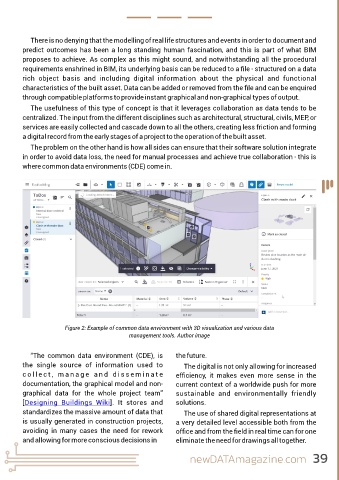
         where common data environments (CDE) come in.


                        Figure 2: Example of common data environment with 3D visualization and various data
                                              management tools. Author image


            “The  common  data  environment  (CDE),  is        the future.
         the  single  source  of  information  used  to           The digital is not only allowing for increased
         c o l l e c t ,   m a n a g e   a n d   d i s s e m i n a t e   efficiency,  it  makes  even  more  sense  in  the
         documentation, the graphical model and non-           current context of a worldwide push for more
         graphical  data  for  the  whole  project  team”      sustainable  and  environmentally  friendly
         [Designing  Buildings  Wiki    ].  It  stores  and    solutions.
         standardizes the massive amount of data that             The use of shared digital representations at
         is usually generated in construction projects,        a very detailed level accessible both from the
         avoiding  in  many  cases  the  need  for  rework     office and from the field in real time can for one
         and allowing for more conscious decisions in          eliminate the need for drawings all together.


                                                                    newDATAmagazine.com 39

